Posts

Showing posts with the label venomous snake

Inland Taipan

Image
Inland Taipan   The inland taipan (Oxyuranus microlepidotus), also commonly known as the western taipan, small-scaled snake, or fierce snake,is a species of extremely venomous snake in the family Elapidae. The species is endemic to semiarid regions of central east Australia.Aboriginal Australians living in those regions named the snake dandarabilla.It was formally described by Frederick McCoy in 1879 and then by William John Macleay in 1882, but for the next 90 years, it was a mystery to the scientific community; no further specimens were found, and virtually nothing was added to the knowledge of this species until its rediscovery in 1972.The inland taipan is dark tan, ranging from a rich, dark hue to a brownish light green, depending on season. Its back, sides, and tail may be different shades of brown and grey, with many scales having a wide, blackish edge.The inland taipan averages about 1.8 m (5.9 ft) in total length, although larger specimens can reach total lengths ...

The King Cobra

Image
 The King Cobra The king cobra (Ophiophagus hannah) is a venomous snake endemic to Asia. With an average length of 3.18 to 4 m (10.4 to 13.1 ft) and a maximum record of 5.85 m (19.2 ft),it is the world's longest venomous snake. Colouration of this species varies across habitats, from black with white stripes to unbroken brownish grey. The sole member of the genus Ophiophagus, it is not taxonomically a true cobra, despite its common name and some resemblance. The king cobra inhabits forests from South to Southeastern Asia where it preys chiefly on other snakes, including those of its kind.  Bites of the    king cobra's skin is olive green with black and white bands on the trunk that converge to the head. The king cobra has a wide distribution in South and Southeast Asia. Like other snakes, a king cobra receives chemical information via its forked tongue, which picks up scent particles and transfers them to a sensory receptor (Jacobson's organ) loca...

Mozambique Spitting Cobra

Image
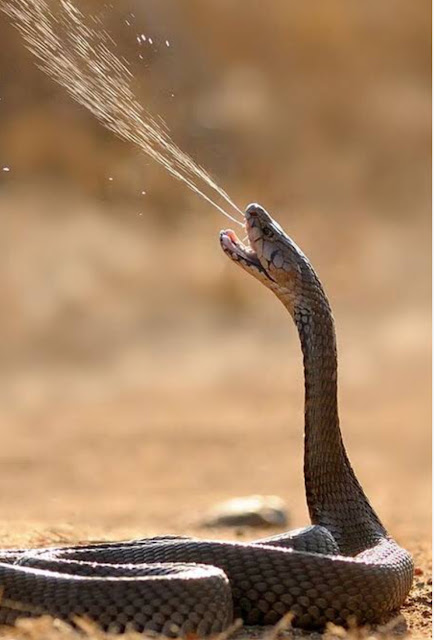
Mozambique Spitting Cobra     The  Mozambique spitting cobra ( Naja mossambica ) is a highly venomous species of  spitting cobra native to  Africa . It is largely found in  Angola ,  Botswana ,  Malawi ,  Mozambique ,  Namibia ,  South Africa ,  Tanzania ,  Zambia , and  Zimbabwe . German naturalist  Wilhelm Peters described this species in 1854. In color, the snake is slate to blue, olive or tawny black above, with some or all scales having black edging.It is a highly venomous type of cobra that is so named because it projects venom from its fangs into its attacker’s eyes, which can cause vision problems or blindness. The venom from its bite can destroy local tissue like the  puff adder . It can spit venom at a distance of 4 to 8 feet.As its name suggests, this cobra spits venom and can hit a target with deadly accuracy from two to three metres away. They are often considered one of the deadliest snake...

Boomslang

Image
Boomslang   boomslang, (Dispholidus typus), venomous snake of the family Colubridae, one of the few colubrid species that is decidedly dangerous to humans. This moderately slender snake grows to about 1.8 metres (6 feet) in length and occurs in savannas throughout sub-Saharan Africa. When hunting, it lies in wait in a bush or tree for chameleons and birds; the forepart of the body often extends motionless into air . Its body and eye colour are extremely variable, and camouflage is excellent. In defense the boomslang inflates the neck, showing the dark skin between the scales; it then may strike. It is rear-fanged, but the fangs are set relatively far forward in the mouth. The venom causes hemorrhages and can be fatal to humans in small amounts.Its name means "tree snake" in Dutch and Afrikaans. It is a colubrid, the largest family of snakes, found on every continent except Antarctica. Like all snakes, boomslangs do not chew – they swallow everything whole. The venom of boomsl...